
The United Nations projects that by 2050, nearly 70% of the world’s population will live in cities, up from about 55% today. This rapid urbanization, combined with the growth of e-commerce, poses significant challenges for how goods and services are distributed efficiently, reliably, and equitably in dense urban environments.
Stanley Lim is an associate professor in the Department of Supply Chain Management at Michigan State University. He is the co-director of the Broad Food Access & Supply Chain Technology (FAST) Lab and a faculty affiliate of the Evolution and Future of Work Research Initiative. He has held visiting appointments at the Massachusetts Institute of Technology, the National University of Singapore, and Singapore Management University. He holds a Ph.D. in Supply Chain Management from the University of Cambridge, a Master’s in Computer Science from the University of Illinois at Urbana-Champaign, and an M.B.A. (with Distinction) from Warwick Business School.
Stanley is an empirical operations economist. His research examines the economics of distribution services in downstream, or so-called “last-mile,” supply chains under operational and societal constraints. Methodologically, he employs causal inference and large-scale field data, complemented by analytical and optimization models, to analyze operational trade-offs and welfare implications. His work has applications to online and brick-and-mortar retail, local package delivery, and food supply chains, with a focus on food waste reduction and recovery efforts. By adopting a cross-domain perspective that integrates operations management, marketing, and economics with customer behavior analytics, his research advances both the theory and practice of retail logistics and provides organizations with actionable guidance on how to distribute their products and services to end consumers efficiently under various conditions.
A central theme of his research is how firms create value by reducing consumers’ search and transaction costs through four core distribution services, the “four A’s”: accessibility, availability, assurance, and assortment. His work deepens understanding of these mechanisms in both digital and nondigital retail contexts, with implications for last-mile delivery performance, retail operations design, and food system efficiency. Stanley’s research is informed by close collaboration with industry and nonprofit partners worldwide, including Meijer, Amazon U.K., Tesco, Ocado, Unilever, Ninja Van, Jerome’s Furniture, Imperfect Foods, and Last Mile Food Rescue, among others. Recognized for his data-driven, interdisciplinary approach, and strong grounding in real-world applications, his research has been honored as a finalist for the INFORMS Daniel H. Wagner Prize and as a semi-finalist for the INFORMS Innovative Applications in Analytics Award. He regularly provides expert commentary on these topics for major media outlets, including Fox News, the Associated Press, NBCUniversal, MarketWatch (a subsidiary of Dow Jones & Co.),The Detroit News, and Detroit Free Press.
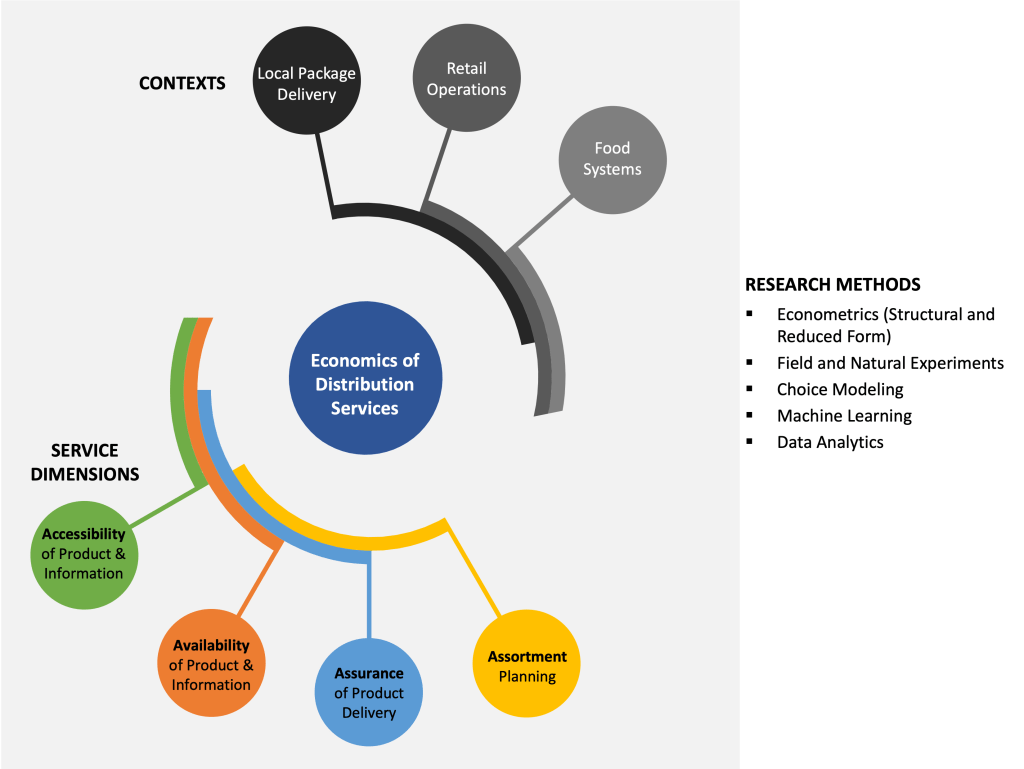
Based on this research agenda, Stanley has developed analytical models for store network and facility location design, service zoning, workload and job assignments, volunteer management, and new service policies. His work includes models that predict failed delivery attempts and integrate those predictions into routing decisions, estimate the opportunity cost of product stockouts for inventory planning, determine optimal return windows for consumer return policies, and evaluate spatial competition to guide store market area design. He has also studied the effects of contract terms on retailer-supplier bargaining power and their economic outcomes, the relationship between delivery workload and performance, the impact of subscription programs on consumer behaviors, and consumers’ sensitivities to lead times and their product return behaviors across channels.
Stanley’s research has been published in Management Science, Manufacturing & Service Operations Management, Production and Operations Management, Harvard Business Review, and MIT Sloan Management Review. His scholarship has been recognized with numerous competitive honors. His Ph.D. dissertation received the 2018 Emerald/EFMD Outstanding Doctoral Research Award in Operations & Production Management and the 2019 James Cooper Memorial Cup from the Chartered Institute of Logistics and Transport (CILT). His research has earned multiple best paper such as the EDSI Best Applications-Oriented Paper, EurOMA Chris Voss Best Paper and Harry Boer Best Student Paper, DSI annual conference Best Student Paper (by a student co-author), CILT Meritorious Paper in Industrial Logistics category, and finalist distinctions across leading conferences and societies, including finalist recognition for the INFORMS Daniel H. Wagner Prize, the INFORMS Innovative Applications in Analytics Award, the INFORMS Transportation Science & Logistics Society Best Paper Award, the INFORMS Behavioral Operations Management Best Working Paper Award, the POMS College of Operational Excellence Junior Scholar Best Paper, the POMS College of Service Operations Best Student Paper Award (by a student co-author), the Emerald Awards Literati Outstanding Paper of the Year, the IJOPM Outstanding Paper of the Year, and the International Symposium on Logistics Best Paper, among others. His pedagogical work has also been nominated for the Case Centre Case Competition (Outstanding Case Writer Category) and the EFMD Case Writing Competition (Women in Business Category). He is named to the 2025 Poets & Quants 50 Best Undergraduate Business Professors honor roll and is a recipient of the 2025 Carol J. Latta Memorial Early Career Research Award (Decision Sciences Institute), the 2025 POMS College of Service Operations Emerging Scholar Award, and the 2020 Paul R. Lawrence Fellowship. His research has been supported by the U.S. Department of Agriculture, the MSU Climate Change Research Support Program, CILT’s HenrySpurrier Scholarships (Top Award, 2016 and 2018), the You Poh Seng Research Grant from the Singapore University of Social Sciences, and projects funded by the U.K. Engineering & Physical Sciences Research Council.
Stanley is deeply engaged in professional service. He currently serves as President of the POMS College of Supply Chain Management and on the INFORMS Daniel H. Wagner Prize Committee. He is a Charter Mentor for Branchfood, the largest community of food entrepreneurs and innovators in New England. He previously served as Chair of Research (Research Tracks) for the 2024 Decision Sciences Institute Annual Conference and has chaired and co-chaired multiple research tracks at INFORMS, POMS, and DSI annual conferences. He has held, or currently holds, editorial roles (associate editor or equivalent) at Manufacturing & Service Operations Management, Journal of Operations Management, Journal of Business Logistics, Service Science, and Decision Sciences Journal, and has received multiple awards for outstanding reviewing and editorial service.
Prior to academia, Stanley served as an officer in the Joint Intelligence and Singapore Guards, an elite infantry formation specializing in rapid deployment, heliborne and urban operations, and later held technical and leadership roles in engineering, logistics planning, and operations within the defense sector. He has received several awards and medals for distinguished performance during his service. He brings this operational experience to his academic work, particularly in the study of urban logistics and system design under real-world constraints.
In his free time, Stanley loves to run and enjoys photography.
Professional Qualifications
- Project Management Professional (PMP)
- IASSC Certified Lean Six Sigma Green Belt (ICGB)
- ITILv3 Foundation Certificate in Service Management
- Cisco Certified Network Professional (CCNP)
- VMware Certified Professional (VCP)
- Certified Cloud Computing Specialist (CCCS)
 stanley-lim.com